

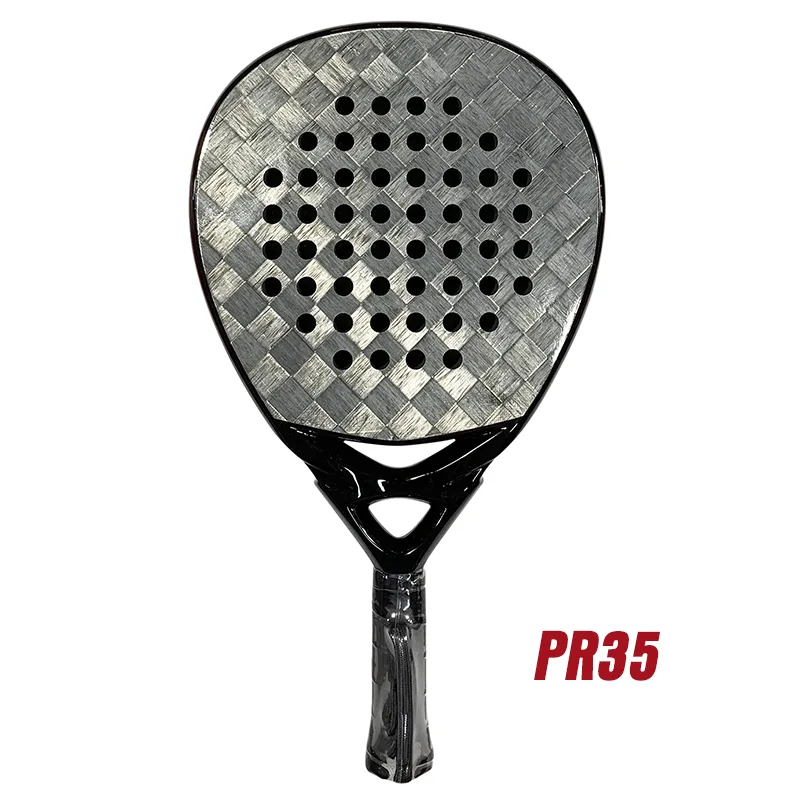
Aluminised carbon fiber fabrics 18K padel rackets combine a distinctive metallic finish with a carbon-fiber composite construction designed for modern racket performance. However, choosing the right racket involves more than selecting a premium-looking surface. Buyers need to understand what 18K carbon means, how aluminised treatments differ from conventional carbon fabrics, how EVA core density affects ball response, and why weight, balance, structural design, and manufacturing consistency matter. This guide explains the essential material characteristics, performance considerations, customization possibilities, and purchasing criteria for players, distributors, and sports equipment brands.
1. What Are Aluminised Carbon Fiber Fabrics 18K Padel Rackets?
Padel has developed into a demanding racket sport in which players need a combination of maneuverability, controlled ball response, structural stability, and dependable durability. As equipment technology advances, manufacturers increasingly explore composite materials that balance these requirements while creating distinctive product designs.
Aluminised carbon fiber fabrics 18K padel rackets use an 18K carbon-fiber fabric with an aluminised or metallic surface treatment in the racket's construction. The term describes a material configuration rather than a complete performance specification. The exact coating process, carbon fabric characteristics, resin system, and laminate design depend on the manufacturer's engineering choices.
For sports equipment brands, this material offers an opportunity to develop premium-looking products with a recognizable surface finish. For players, its value depends on how the material works together with the racket's core, frame, shape, and weight distribution.
Why Are These Rackets Attracting Attention?
- Distinctive appearance: A metallic finish can create a modern, technical look that differentiates a racket collection.
- Composite construction: Carbon-fiber reinforcement provides a lightweight structural option for racket design.
- Design flexibility: Manufacturers can combine different fabric layers, core materials, and frame configurations.
- Premium product positioning: A specialized surface material can support a higher-end product concept when accompanied by appropriate construction quality.
- Customization potential: Surface finishes, graphics, logos, grips, and other components can be tailored to a brand's requirements.
Nevertheless, a metallic appearance alone does not prove superior strength, greater power, or longer service life. Buyers should assess the complete racket and request supporting specifications or test results before making performance claims.
2. What Does 18K Carbon Fiber Mean?
The designation 18K refers to approximately 18,000 individual filaments in a carbon-fiber tow, the bundle of fibers used to manufacture a fabric. The K stands for one thousand. Correspondingly, 3K and 12K generally describe tows containing approximately 3,000 and 12,000 filaments.
This designation describes the fiber bundle, not the overall quality grade of the finished racket. Fabric weight, weave pattern, fiber grade, resin content, layer orientation, and molding conditions all affect the final composite structure.
How Can 18K Carbon Fiber Affect Racket Design?
The larger tow associated with 18K carbon can produce a more pronounced woven pattern than some lower-K fabrics. Its structural contribution, however, depends on how the fabric is incorporated into the racket.
For example, two rackets labeled 18K may feel different because one uses a softer EVA core and a more flexible laminate, while another uses a firmer core and a different reinforcement arrangement. Neither the filament count nor the surface appearance determines the entire playing experience.
- Carbon-fiber grade and fabric specification.
- Fabric weight, weave, and resin compatibility.
- Number, orientation, and placement of reinforcement layers.
- Interaction between the face, frame, and EVA core.
- Consistency between prototypes and production units.
For procurement teams, the practical question is not simply whether a racket uses 18K carbon. It is whether the specified material and complete construction deliver the intended feel, durability, and price positioning for the target market.
3. How Does Aluminised Carbon Fiber Fabric Work?
Aluminised carbon fiber fabric combines carbon-fiber reinforcement with an aluminium-based metallic surface treatment or finish. The precise process may vary, so buyers should confirm whether a product uses a deposited coating, a metallised layer, or another manufacturer-specific treatment.
This distinction matters because the treatment process and its integration with the composite can affect appearance, surface consistency, adhesion, and production requirements.
Potential Benefits of an Aluminised Finish
- Visual differentiation: The metallic effect creates an alternative to conventional exposed carbon patterns.
- Premium styling: A reflective or silver-toned surface can complement modern graphics and branded finishes.
- Product range expansion: Brands can introduce a distinct material option within an existing racket collection.
- Design versatility: The finished surface can be coordinated with paint colors, logos, and decorative elements, subject to process compatibility.
What Should Buyers Avoid Assuming?
Aluminisation does not automatically make a racket stronger, more impact-resistant, more comfortable, or less prone to vibration. Those outcomes depend on the complete composite system and must be established through appropriate testing.
Similarly, claims about heat resistance or stable performance across temperature changes should be supported by product-specific evidence. The presence of a metallic treatment alone is insufficient to establish such benefits.
For private-label and OEM projects, it is advisable to request material documentation, inspect finished samples, and confirm that the desired appearance remains consistent after molding, drilling, finishing, and normal handling.
4. How Do Materials Influence Padel Racket Performance?
A padel racket is a coordinated system. The hitting surface influences how the ball feels at contact, while the core, frame, shape, balance, and total mass affect maneuverability and the player's ability to control shots.
Power and Ball Rebound
Players often associate a firmer racket construction with a more direct response during aggressive shots. However, actual ball rebound depends on several interacting variables, including core compression, laminate stiffness, contact location, swing speed, and the incoming ball.
An 18K aluminised surface may form part of a racket designed for offensive play, but the material label by itself cannot guarantee harder smashes. The complete design should be evaluated through practical hitting tests.
Control and Shot Placement
Reliable control requires predictable responses across different impact locations. The racket's shape, balance, torsional stability, and construction consistency can all affect how easily players direct the ball during volleys, defensive returns, and shots close to the glass.
Manufacturers should therefore assess the finished racket rather than judging control by the carbon specification alone.
Comfort and Vibration
Impact sensation is influenced by the racket's core density, laminate arrangement, grip construction, and vibration characteristics. A firm surface may feel precise to one player but demanding to another.
Players who experience arm discomfort should consider the entire equipment setup and their playing technique rather than assuming that a particular carbon fabric will eliminate vibration or prevent injury.
Durability and Structural Stability
Racket durability depends on fiber integrity, resin quality, molding accuracy, frame design, drilling quality, and resistance to repeated impacts. A well-designed composite structure can provide a useful strength-to-weight balance, but no material makes a racket immune to cracks, edge damage, or delamination.
For commercial buyers, repeatable production quality is particularly important. A stable manufacturing process helps reduce unwanted variation between samples and mass-produced rackets.
5. What Components Determine Overall Racket Quality?
When assessing an aluminised 18K padel racket, buyers should examine several components together instead of focusing exclusively on the visible hitting surface.
Hitting Surface
The face material affects the racket's structural behavior and appearance. Buyers should verify the specified carbon fabric, the use and location of any metallic treatment, and whether the construction uses the same material on both faces.
Frame and Reinforcement
The frame provides structural support around the racket. Carbon reinforcement, layer orientation, resin distribution, and molding quality all contribute to its behavior under load.
Manufacturers should also assess the throat and bridge areas, where the geometry and reinforcement design influence the racket's structural response.
EVA Core Density
EVA foam is widely used in padel racket cores. Different formulations and densities can produce different compression, rebound, and impact sensations.
A softer core may compress more readily, while a firmer core may produce a more direct response under certain conditions. These are general tendencies, not universal rules: foam formulation, thickness, laminate design, and testing conditions also matter.
Weight, Balance, and Shape
Total weight and balance affect maneuverability and swing effort. Racket shape also influences the distribution of mass and the location of the effective hitting area.
For example, a lighter racket may be easier for some players to maneuver during quick exchanges, while a different balance can suit players seeking a particular swing feel. The appropriate setup depends on playing style, physical comfort, and experience.
6. How Do Different Racket Materials Compare?
Comparing material options helps buyers select a construction that matches their product strategy and intended audience. The following table summarizes general considerations rather than guaranteeing specific playing outcomes.
| Material Option | Typical Design Consideration | Potential Application | What to Verify |
|---|---|---|---|
| Fiberglass | Can provide a more flexible or elastic face response depending on construction. | Comfort-oriented and value-focused racket ranges. | Fabric specification, core pairing, and finished feel. |
| 3K Carbon Fiber | Uses approximately 3,000 filaments per tow and can create a fine woven appearance. | Rackets with varied performance and styling targets. | Fiber grade, laminate design, and actual stiffness. |
| 12K Carbon Fiber | Uses approximately 12,000 filaments per tow and offers a different fabric pattern. | Mid-range or premium product development, depending on the complete design. | Fabric weight, weave, resin, and core compatibility. |
| 18K Carbon Fiber | Uses approximately 18,000 filaments per tow and can create a pronounced weave. | Performance-focused or premium-positioned product collections. | Complete laminate specification and prototype results. |
| Aluminised 18K Carbon Fiber | Combines 18K carbon fabric with a metallic surface treatment or finish. | Distinctive premium designs and customized product lines. | Treatment method, surface adhesion, finish consistency, and performance evidence. |
| Hybrid Carbon and Fiberglass | Combines different reinforcement materials to tune the composite structure. | Products targeting a particular balance of feel, cost, and construction. | Layer sequence, material proportions, and finished-racket behavior. |
There is no universally superior material for every player or price segment. A carefully engineered hybrid construction may suit a particular use case better than an 18K design. The correct choice depends on measurable product requirements and feedback from representative players.
7. What Should Buyers Check Before Purchasing?
Choosing a supplier for aluminised carbon fiber fabrics 18K padel rackets requires more than comparing quotations. Product specifications, sample quality, manufacturing controls, and communication should all be assessed before a large order is placed.
Confirm the Complete Product Specification
Request a written specification covering the face material, frame material, core, weight, balance, thickness, dimensions, surface treatment, and finishing requirements.
For example, a manufacturer may offer several EVA core densities and weight configurations. Buyers should confirm which configuration applies to the quoted model rather than relying on a general product description.
Evaluate Sample Quality
Sample approval helps reveal differences that may not be apparent in a product listing. Inspect the racket for surface uniformity, edge finishing, drilling accuracy, grip comfort, and visible manufacturing defects.
Where possible, arrange practical hitting tests with players who represent the intended customer group. Feedback should cover maneuverability, ball response, control, and comfort.
Review Quality Control Procedures
Ask how the supplier manages incoming materials, layer placement, molding, finishing, dimensional inspection, and final product checks. Clarify whether production batches are inspected against approved samples and documented specifications.
For larger orders, agree on acceptable tolerances for weight and balance, inspection methods, defect handling, and procedures for resolving quality discrepancies.
Assess Customization and Production Support
For brands developing their own racket collections, supplier capabilities may include logo application, surface graphics, paint finishes, packaging, and modifications to selected product specifications. More extensive projects may require new molds or a revised structural design.
Before committing to a production schedule, confirm sample lead times, minimum order quantities, packaging requirements, tooling arrangements, and the process for approving design changes.
- Confirm the exact 18K fabric and aluminised treatment.
- Document the complete racket configuration.
- Request samples and approve a reference unit.
- Review production quality controls and inspection criteria.
- Verify customization scope, order quantities, and delivery arrangements.
- Agree on packaging, branding, and after-sales procedures.
8. How Can Manufacturers Customize 18K Padel Rackets?
Customization enables sports brands, distributors, and retailers to develop products that match their positioning, visual identity, and customer expectations. The most effective projects begin with a clear product brief rather than selecting materials solely because they appear premium.
Surface and Graphic Customization
Options may include metallic finishes, customized colors, brand logos, decorative graphics, matte or gloss effects, and selected textured finishes. The available choices depend on the coating system, production process, and compatibility of the materials.
Buyers should request physical samples or approved digital proofs before production. This helps establish expectations for color, pattern placement, logo dimensions, and the finished appearance.
Weight, Balance, and Core Options
Depending on the supplier's capabilities, buyers may specify different target weights, balance points, and EVA core configurations. These parameters should be developed together because changing one element can affect the overall racket response.
Customization should be supported by prototype evaluation to ensure the final design meets the intended playing requirements.
OEM and ODM Development
OEM projects generally focus on producing products according to an agreed customer specification, while ODM projects can involve more extensive design and development support. The precise scope varies by supplier and contract.
Nanjing Spark Shot Technology Co.,Ltd. offers a relevant starting point for brands exploring customized carbon-fiber racket development. Buyers can discuss material choices, graphics, components, and product specifications according to their project needs.
When evaluating a development partner, ask for clear information about available customization options, prototype procedures, tooling responsibilities, quality standards, and production capacity. Confirm the details for the specific project rather than assuming that every option is available for every model.
9. How Can Players Maintain Their Rackets?
Good maintenance helps preserve the racket's finish and makes it easier to identify damage before the next match. Even a well-manufactured carbon-fiber racket can be affected by hard impacts, improper storage, and repeated exposure to unsuitable conditions.
Clean the Surface Carefully
Use a soft cloth to remove dust and surface marks. Follow the manufacturer's cleaning recommendations, and avoid harsh solvents or abrasive tools that may damage the finish.
Protect the Frame and Edges
Repeated impacts against walls, floors, or other hard surfaces can damage the racket. Handle the equipment carefully and use a suitable protective cover when transporting it.
Store the Racket Appropriately
Avoid leaving the racket for extended periods in a hot vehicle or other environments with extreme temperatures. Follow the manufacturer's storage recommendations to help protect the resin system, core, and surface finish.
Inspect for Damage
Check the frame, face, edges, and handle periodically for cracks, loose components, or visible separation between layers. If structural damage is suspected, stop using the racket until its condition has been assessed.
10. Frequently Asked Questions
1. What does 18K mean in an 18K padel racket?
18K refers to approximately 18,000 individual filaments in a carbon-fiber tow. It describes the fiber bundle used in the fabric, not a guaranteed performance grade or a complete measure of racket quality.
2. What are aluminised carbon fiber fabrics?
They are carbon-fiber fabrics incorporating an aluminium-based metallic treatment or finish. The exact process varies by product, so buyers should confirm the material construction and surface treatment with the manufacturer.
3. Are aluminised 18K padel rackets always more powerful?
No. Power depends on the complete racket design, including the face laminate, core, frame geometry, balance, and the player's swing. The 18K designation and metallic finish alone cannot establish that a racket will generate more power.
4. Is 18K carbon better than 3K or 12K carbon?
Not automatically. These labels describe different filament counts per tow. Fiber grade, fabric construction, layer orientation, resin system, and core selection all influence the finished racket's characteristics.
5. Does aluminised carbon fiber reduce vibration?
Not necessarily. Vibration behavior depends on the complete composite structure, core, grip, and racket geometry. Buyers should request relevant test information instead of assuming that a metallic treatment guarantees improved comfort.
6. Can manufacturers customize aluminised 18K padel rackets?
Depending on the supplier, customization may include logos, graphics, colors, surface finishes, grips, packaging, and selected structural specifications. New molds or more extensive design changes may require additional development work.
7. What specifications should distributors request?
Distributors should request face and frame materials, the exact core configuration, weight, balance, dimensions, finishing details, quality tolerances, packaging specifications, and available customization options. Sample approval is also recommended before mass production.
8. Are 18K aluminised padel rackets suitable for beginners?
They can be, provided the complete racket suits the player's ability and preferences. Beginners should consider maneuverability, comfort, balance, and ease of control rather than choosing equipment solely on the basis of its material designation.
9. How can buyers verify a supplier's product quality?
Request written specifications, production samples, documented inspection procedures, and relevant test reports. For larger orders, establish clear acceptance criteria and confirm how the supplier handles defects or differences from the approved sample.
10. What should brands consider when sourcing OEM padel rackets?
Brands should evaluate product development support, material traceability, customization capabilities, sample approval, production consistency, minimum order quantities, lead times, and communication. The final decision should reflect the project's technical requirements and commercial objectives.
11. Conclusion: Choosing the Right 18K Padel Racket
Aluminised carbon fiber fabrics 18K padel rackets offer an interesting combination of carbon-fiber construction and metallic styling for brands seeking differentiated sports equipment. Their suitability, however, depends on much more than the material name printed on a product specification.
Understanding the meaning of 18K, confirming the aluminised treatment, evaluating the EVA core, and reviewing the complete frame and face construction can help buyers make better-informed decisions. Sample testing and clear manufacturing specifications are equally important for ensuring that a finished racket meets the intended quality and playing requirements.
For distributors, retailers, and sports brands, the best sourcing strategy is to match material selection with the target market, approve a representative sample, and establish measurable production standards before placing a large order.
Develop Your Next Padel Racket Collection with Confidence
Looking for customized carbon-fiber padel rackets for your brand or distribution business? Nanjing Spark Shot Technology Co.,Ltd. can discuss material configurations, product styling, and OEM/ODM development requirements with your team.
Share your target specifications, market positioning, and customization ideas to explore a suitable product solution. Contact Us.