

OEM Fixed Roller Gate Systems for Durable Industrial Access Control
2026-09-27
A stuck gate at 6 a.m. rarely stays a minor nuisance. It turns into a line shutdown, a security gap, and a maintenance call nobody wanted. For industrial sites that cycle access gates hundreds of times a week, off-the-shelf hardware often fails exactly where it should hold. OEM fixed roller gate systems solve this by matching roller design, load rating, and clearance to your specific operation—not a generic template. That’s the approach THT brings to durable industrial access control. Here’s a look at why fixed roller configurations outperform conventional setups and what to check before specifying your next system.
Fixed Roller Gates for Industrial Facilities Where Swing Barriers Slow Everything Down
Most industrial sites learned years ago that a swinging barrier is a bottleneck dressed up as a safety device. Every opening means clearing a radius, waiting for the gate to arc across the walkway, and then reversing the motion just to let one forklift through. Over a shift, that back-and-forth adds up to real downtime.
Fixed roller gates sidestep that entire problem by moving along a straight track that stays tight to the wall or guardrail. There's no wide sweep, no need to block an adjacent aisle, and no heavy panel hanging out in traffic. A single worker can slide the gate open with one hand, and it locks into place without any extra effort.
For loading docks, mezzanine edges, conveyor access points, or any high-traffic opening, that straight-line motion keeps the work area clear and the pace steady. Instead of slowing down for a swinging barrier, crews just roll the gate, do the job, and roll it back—no arc to dodge, no minutes lost.
OEM Roller Gate Configurations Addressing Real-World Wear Points
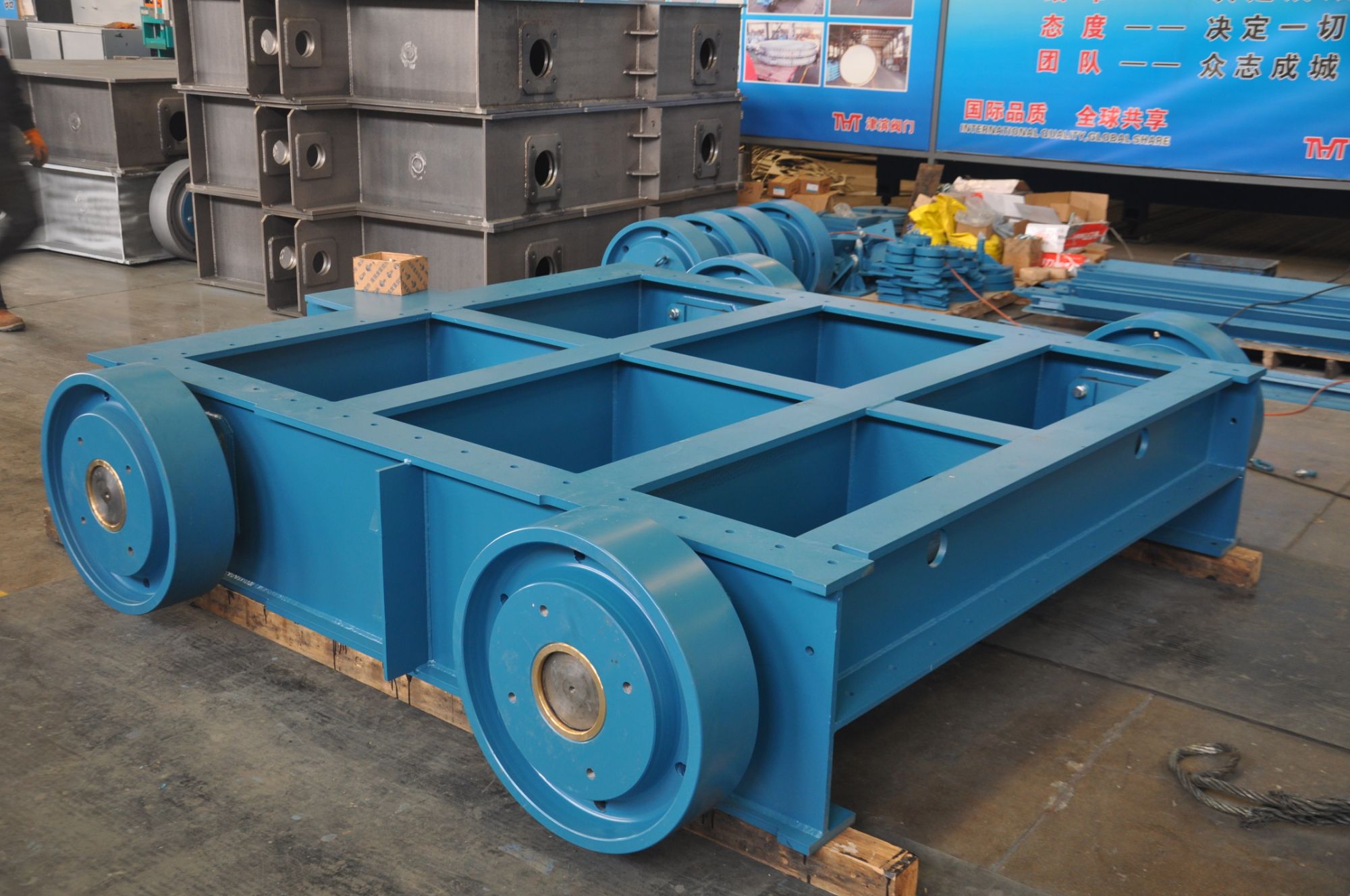
Field maintenance records consistently point to three recurring trouble zones on roller gates: the guide track interface, the roller bearing seat, and the bottom seal channel. OEM configurations that last tend to share a common trait—they harden these specific areas rather than adding bulk elsewhere. For example, some designs use a dual-flange roller that captures the track rail from both sides, cutting lateral drift that normally accelerates wall wear. Others shift the bearing from a press-fit cup to a bolted cartridge, simplifying replacement when grit eventually works its way past the shield.
The bottom seal channel eats more downtime than it should. Standard folded sheet metal traps debris and corrodes from the inside out, but OEM setups built for harsh duty often replace it with an extruded profile that drains freely and accepts a snap-in rubber sweep without adhesive. A few manufacturers go further and offset the end cap fasteners so they sit clear of the runoff path—small change on paper, but it eliminates a rust point that field crews keep circling back to.
What separates a config designed around wear points from a generic one is the way tolerances are stacked when the gate is fully loaded. Instead of tightening every joint, OEM solutions introduce deliberate clearance at the hinge pin and spring anchor, then pull the chain tight at the mid-rail. That lets the gate flex under wind load without transferring the stress into the roller axles—the failure mode that most often turns a simple re-hang into a full track rebuild. It is not the most visible upgrade, but it is the one that keeps the gate square after years of slamming.
The Bearing Detail Keeping Durable Gate Systems Running Quietly for Years
Most gate failures don't start with a snapped hinge or a cracked panel. They begin inside the rolling assembly, where a single bearing loses its tolerance and starts grinding against the race. That subtle roughness translates into a low-frequency vibration, then an audible squeak, and finally a jerky movement that stresses every weld and fastener. Over time, the entire system works harder just to cover the same distance.
Quality sealed bearings change this pattern. Instead of exposing steel balls to moisture and grit, the best designs integrate a double-lip contact seal and a high-temperature grease that stays put through freeze-thaw cycles and afternoon sun. The result is a door that glides along its track with almost no lateral play, even after thousands of cycles. You don't hear it, and more importantly, the motor doesn't feel it.
For property owners, this quiet operation matters more than they realize. A gate that runs smoothly demands less maintenance, fewer emergency repairs, and no awkward explanations to neighbors about the screech at 6 a.m. The right bearing detail doesn't just extend service life—it preserves the experience of using the gate every single day.
Merging Roller Gate Access Control With Legacy Badge Systems Without Major Rewiring
Integrating roller gate access control with an existing badge system often stalls on the assumption that every reader and lock must be rewired to match the new panel. In practice, many legacy badge readers communicate over Wiegand, magnetic stripe, or simple dry-contact signals that can be captured at the controller side. By inserting a small protocol bridge—typically a DIN-rail module near the existing access controller—you can translate those legacy reader outputs into whatever the roller gate controller expects, whether that's Wiegand, OSDP, or a relay closure. This approach keeps the existing reader cabling and badge population intact while adding the gate motor control as a separate logical output on the same credential event.
A key trick is to treat the roller gate not as a door replacement but as an additional actuator tied to the same access decision. Many facilities already have spare relay outputs on their legacy access control panels, or they can add a low-cost expansion board that listens to the panel's data bus. For example, if the panel supports RS-485 downstream devices, a single twisted pair can carry the unlock command to a gate interface that then handles motor run timing, safety sensor feedback, and obstruction detection locally. This means you don't pull new wire from the badge reader to the gate; you only extend the existing data bus or use a wireless bridge for that short hop.
Before cutting over, run both systems in parallel for a few days to compare access logs. Look for mismatch cases such as a badge that grants door access but should be denied at the roller gate due to vehicle restrictions. Since the logic now lives in software mapping rather than physical wiring, you can adjust permissions per gate without touching field hardware. If the integration fails at any point, the original badge system continues to operate the pedestrian doors, and you can fall back to a manual release or a temporary standalone keypad at the gate while debugging the bridge. That kind of graceful degradation is often the real reason facilities choose this method over a full rip-and-replace.
Heavy-Duty Track and Frame Choices Extending Service Life in Tough Environments
Heavy-duty tracks and frames aren't just about thicker steel—they're about anticipating where the machine will hurt first. In rocky overburden or abrasive sand, standard undercarriages wear unevenly, leading to premature pin and bushing failure. By specifying induction-hardened link surfaces and full-length frame reinforcements, operators see a real shift: the same hours on the meter, but with fewer mid-shift adjustments and less slop in the final drive alignment.
Frame flex is the quiet killer in tough environments. When a machine works across broken ground or constantly swings against a hard bank, micro-torsion accumulates at the bolster joints and slew bearing seat. A heavy-duty frame isn't just heavier—it's gusseted where the stress maps show cracks will start, and the track pads are matched to the ground pressure profile. That combination keeps the chain from scalloping the idlers and stops the track group from walking off under side load.
Uptime in a quarry or demolition site comes down to how well the track group shrugs off impact. Deep-hardened bushings, sealed and lubricated track chains, and frame plates with a high yield strength all work together. The result isn't a machine that simply lasts longer—it's one that holds its adjustment, keeps the tracks centered, and spends fewer hours in the shop for undercarriage rebuilds. That's the difference between a spec sheet promise and what the maintenance crew actually sees at 4,000 hours.
Handling Forklift Lanes and Pedestrian Access With a Single Fixed Gate Design
Combining forklift traffic and pedestrian movement through a single fixed gate often feels like an impossible compromise: widen it for trucks and you invite foot traffic into a danger zone, narrow it for people and you slow down loading operations. A better starting point is to think of the fixed gate not as a simple opening, but as a transition that actively separates flow types by timing and visual cues. For example, placing the gate at the end of a short, clearly marked pedestrian bypass corridor allows workers to walk around the gate while forklifts pass through it, without ever sharing the same physical lane. The gate itself remains fixed in width—wide enough for a standard lift truck with a few inches of clearance on each side—but its surrounding layout does the real work of keeping people out of the truck path.
Physical barriers that extend beyond the gate posts make this separation more intuitive. Short sections of guardrail or bollards set back from the gate opening can force pedestrians to take the designated side route, while still giving forklift operators an unobstructed straight line through the gate. Adding a slight floor-level change—such as a 40 mm raised walkway edge or a contrasting textured strip along the pedestrian side—reinforces the boundary without requiring movable parts. Many sites also paint the gate frame in a high-visibility color and add a pedestrian crossing symbol only on the bypass route, never on the forklift lane itself. These details remove the need for constant supervision or signage that drivers and workers eventually stop noticing.
One overlooked advantage of a single fixed gate is predictability. Unlike swing gates or retractable barriers that can be left open, blocked by debris, or broken, a fixed gate always presents the same geometry. Forklift operators learn the exact clearance by muscle memory, and pedestrians learn that the opening is not meant for them. If occasional pedestrian access through the gate becomes unavoidable—for maintenance or emergency egress—consider a fixed pedestrian wicket cut into the larger gate leaf, placed far enough from the forklift path that a person standing in it remains outside the truck's turning radius. This keeps the one-gate solution intact while adding a controlled exception that does not compromise daily separation.
FAQ
These gates are commonly used in warehouses, manufacturing plants, loading docks, and secure perimeters where frequent vehicle or pedestrian access needs to be controlled without compromising durability.
The fixed roller mechanism reduces moving parts that can wear out, and when built with corrosion-resistant materials, it stands up to dust, moisture, and temperature swings better than conventional sliding gates.
Yes, OEM suppliers typically offer customization in width, height, roller spacing, and integration with access control hardware like card readers or intercoms, ensuring the gate fits both the physical layout and operational needs.
Routine checks every few months are enough for most installations. Lubricate the rollers and track, inspect for debris buildup, and verify that all mounting bolts remain tight. No special tools are required.
For many facilities, yes. They offer a stable, guided movement that prevents swaying in windy conditions, and the fixed track distributes weight evenly, which can extend the life of the gate panels.
Galvanized steel is standard, but powder-coated aluminum or stainless steel options are also common for chemical plants, coastal areas, or food processing facilities where rust resistance is critical.
Working directly with an OEM usually means shorter lead times for custom dimensions and easier access to replacement rollers, track sections, and hardware, since the manufacturer controls the full production process.
Important additions include photoelectric sensors to stop closing when an obstruction is detected, manual release mechanisms for power outages, and warning signs or lights to alert nearby workers.
Conclusion
Swing barriers have a habit of turning a busy loading dock into a waiting line. Fixed roller gates eliminate that choke point because the panel slides along a track instead of arcing into traffic, so forklifts and pedestrians keep moving without someone holding a gate open. What separates a gate that lasts from one that starts rattling in six months is how the OEM configuration handles real-world wear points. Instead of generic brackets and exposed rollers, the better designs include hardened steel axles, sealed bearing cartridges, and replaceable guide blocks. The bearings matter more than most facility managers expect. A deep-groove sealed bearing with proper preload keeps the rolling action quiet and smooth, even after years of dust, washdowns, and temperature swings. That quietness isn't cosmetic; it means less friction, less heat, and fewer unplanned maintenance calls.
On the access control side, retrofitting doesn't have to mean tearing out conduit or replacing every card reader. Fixed roller gate systems can be ordered with OEM mounting plates and internal cable channels that align with existing badge readers, request-to-exit sensors, and safety loops. A dry contact or Wiegand pass-through is often enough to let the gate respond to the same credentials already used at the employee entrance. For harsh environments, the track and frame choices are where durability is won or lost. Hot-dip galvanized steel or powder-coated aluminum tracks resist corrosion, while bolt-on guide rails make it possible to swap a worn section without replacing the entire frame. In mixed traffic areas, a single fixed gate design can serve both forklift lanes and pedestrian paths when the clear opening is sized correctly and the panel includes a pedestrian pass door or a separate speed gate. That avoids the clutter of multiple barriers and keeps the traffic flow predictable, which is exactly what industrial sites need.
Contact Us
Contact Person: Su Zhang
Email: [email protected]
Tel/WhatsApp: +86-25219206
Website: https://www.tht-valve.com/