

Glass Filled PTFE Tube Exporter Delivering Precision Tubing Solutions Worldwide
2026-10-20
Precision tubing demands more than standard materials—it requires a partner who understands the subtle balance between strength, thermal stability, and dimensional accuracy. TAIFNO, a specialized glass filled PTFE tube exporter, has built a global reputation for delivering exactly that: tight-tolerance solutions that hold up in demanding applications across chemical processing, aerospace, and fluid handling. In this post, we'll explore what sets their approach apart and why engineers keep coming back.
Glass Filled PTFE Tubes That Hold Their Own Around the World
Glass filled PTFE tubes bring a practical edge to demanding applications across multiple industries. The addition of glass fibers stiffens the base polymer, reducing cold flow and improving dimensional stability under load. That means these tubes keep their shape and sealing ability where pure PTFE might slowly deform, making them a dependable choice for valve seats, pump components, and electrical insulation in challenging environments.
What sets them apart is how well they hold up against wear, chemicals, and temperature swings without becoming brittle. The glass reinforcement raises compressive strength and cuts thermal expansion, so parts machined from these tubes stay true to spec even after repeated cycling. From chemical processing plants in Europe to water treatment facilities in Asia, engineers turn to them when tight tolerances and long service life matter more than a marginal gain in chemical inertness.
Machinability also plays a big role in their global appeal. Glass filled PTFE tubes can be turned, milled, or drilled into precise custom components without the tool gumming issues sometimes seen with unfilled grades. Shops appreciate the clean cuts and consistent surfaces, while end users benefit from parts that resist creep and maintain a reliable seal. It is this balance of strength, stability, and workability that keeps them specified on projects where failure is not an option.
Precision Machining That Does Not Waver at Tight Tolerances
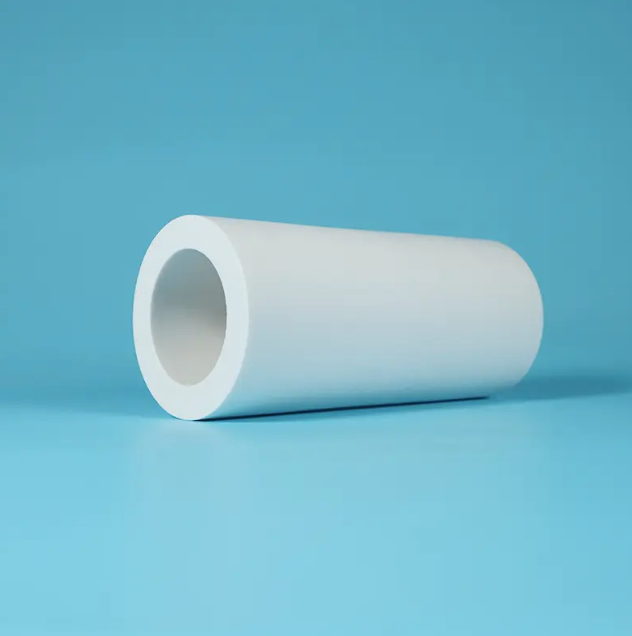
Holding a few microns repeatedly is less about the machine's specs and more about controlling everything around it. Shop temperature, tool wear, coolant concentration, and even the way a blank is clamped can nudge a dimension out of tolerance. We keep the floor within a narrow temperature band, replace cutting edges on a schedule built from actual wear data, and verify every critical feature before the part leaves the fixture.
Materials are rarely as stable as their data sheets suggest. Residual stress from prior processing, minor differences between heats, and how the workpiece responds under a specific depth of cut can shift results. Instead of relying on an operator's feel, we track how each material batch machines and make small parameter adjustments early, so the final cuts stay predictable and quiet.
At tight tolerances, inspection is not a checkpoint after machining—it is part of the process. In-machine probes, air gaging, and regular calibration keep the measurement loop tight and align it with the same datums used for cutting. That way, we do not mistake gage drift for a bad part, and the piece that leaves the shop still measures in tolerance on the customer's equipment.
Custom Tube Sizes Without the Minimum Order Guilt Trip
Need a tube that’s 3.7 inches instead of the standard 4? We won’t make you order a thousand just to hit some arbitrary minimum. You pick the exact diameter, wall thickness, and length—whether it’s one piece or a few dozen—and we’ll cut it to spec without making you feel like a small fry.
Most suppliers treat custom sizes like a favor. You get the sigh, the long lead time, or the “well, if you insist” pricing. Not here. Our process is built for flexibility, so you can request an oddball dimension and actually get it without the lecture about economies of scale.
Stop settling for a close-enough size that forces you to redesign your project. Tell us what you really need, and we’ll make it happen—no guilt, no inflated minimums, just tubes that fit the first time.
Chemical Resistance That Keeps Processes Running Longer
Chemical attack often shows up quietly—softened gaskets, hairline cracks in pump housings, or slowly thinning liner walls—long before a full failure interrupts production. Specifying materials with proven resistance to acids, alkalis, solvents, and oxidizing agents isn't just about avoiding leaks; it directly determines how many operating hours you get between shutdowns.
The difference shows in small details. A fluoroelastomer seal that holds its durometer after months in hot sulfuric acid. A polypropylene tank fitting that doesn't stress-crack around chlorine dioxide. A PTFE-lined valve that still cycles smoothly after thousands of exposures to mixed solvents. These choices keep maintenance crews off the line and let batches finish on schedule.
When chemical compatibility is treated as an engineering requirement rather than an afterthought, mean time between failures rises. Plants see fewer unplanned washouts, less contamination risk, and longer service life from pumps, valves, tanks, and instrumentation—so the process keeps moving instead of waiting on replacements.
Export Packaging Built to Avoid Damage on the Long Haul
Long-haul export shipping punishes weak packaging in ways domestic freight never will. Containers roll, pitch, and shudder for weeks, and boxes at the bottom of a stack can bear several tonnes. Standard corrugated cartons rated for local delivery often fail here—crushing corners, splitting seams, or letting contents shift until they abrade each other. Effective export packaging starts with a realistic assessment of stacking height and vibration frequency, then adds reinforced corner posts, double-wall or triple-wall board, and internal bracing cut to the exact void space.
Moisture is the quiet destroyer on ocean routes. Even “sealed” containers breathe with temperature swings, drawing in humid air that condenses on cold metal walls. Export packaging must include a vapour barrier—polyethylene film, foil laminate, or desiccant packs—but that alone is not enough. Wooden crates need heat treatment or fumigation certificates, and metal parts require volatile corrosion inhibitor films or oil coatings. A common mistake is wrapping everything tightly in plastic, which traps condensation against the product. Better to allow controlled airflow while blocking liquid water and salt spray.
Palletisation and load planning prevent damage before the box is even closed. A pallet that overhangs its base or sits unevenly will transfer shocks directly into the goods. Export-grade pallets should be heat-treated to ISPM 15, with strapping that pulls inward rather than downward. Inside the container, leave no lateral gaps: use airbags, timber dunnage, or purpose-built foam blocks to lock the load into place. Also consider that customs may open and reseal packages—design closures that can be inspected and re-secured without destroying the protective layers.
Traceable Test Data with Every Batch We Ship
When a batch ships, the box isn’t the only thing that arrives. Inside you’ll find the lab sheets, instrument readouts, and calibration logs that belong to that specific production run. No generic certs, no “representative sample” fine print. If a lot number is stamped on the label, the numbers behind it are attached.
That means if a question ever comes up six months later — about a raw material lot, a furnace temperature curve, or a hardness reading — you can pull the batch file and see exactly what happened. We keep the raw data, not just pass/fail summaries, and we ship it with the product so your own QA team doesn’t have to chase it down.
FAQ
The addition of glass fibers significantly improves compressive strength and dimensional stability, so the tubing holds its shape better under load and temperature changes while still offering the low friction surface PTFE is known for.
We regularly supply sectors like chemical processing, oil and gas, aerospace, and electrical insulation. These environments demand tubing that can handle aggressive media, high pressures, or tight tolerances without deforming.
Yes, we work from detailed drawings or samples. We can produce non-standard diameters, wall thicknesses, and lengths, and we keep tolerances consistent from prototype runs through full production batches.
Every batch goes through dimensional checks, tensile testing, and visual inspection before packing. We also document material certificates and test reports so you can trace each shipment back to its production lot.
Depending on the diameter and length, we use reinforced cardboard tubes, wooden crates, or custom foam-lined boxes. The goal is to prevent bending, scratching, or moisture exposure during long-distance shipping.
Yes, our technical team can share cutting, drilling, and fitting recommendations based on the grade you order. We also flag any handling considerations since glass filled PTFE is more rigid than unfilled PTFE.
For standard sizes, we usually ship within two to three weeks after order confirmation. Custom dimensions or large volumes may add another week or two, but we confirm the schedule before you commit.
We can supply material that meets ASTM, AMS, or equivalent specifications depending on the region. Each shipment includes the relevant compliance documentation without needing to request it separately.
Conclusion
When glass filled PTFE tubing leaves our facility, it has to perform in places we may never see. That means dimensional stability that holds up whether the tube ends up in a sweltering offshore rig or a sub-zero chemical plant. Our precision machining doesn't flinch at tight tolerances—we routinely hold ±0.05 mm on diameters and wall thickness because a flange that fits in one country should fit in another without any rework. If your required size isn't on a standard chart, we don't push back with a huge minimum order; instead, we cut the profile you need, even for a short run. It's about letting your process dictate the tube, not the other way around.
Chemical resistance is where these tubes earn their keep. Aggressive acids, solvents, and process fluids that chew through lesser polymers leave glass filled PTFE largely unfazed, which stretches maintenance intervals and keeps production lines running longer. When it comes to shipping, we don't just drop tubes in a box—export packaging is designed with bracing, moisture barriers, and shock absorption that survive multiple handling stages and long ocean transits. Every batch that goes out carries its own traceable test data: raw material certifications, dimensional inspection reports, and mechanical property results. That way, when your customs clearance or QA team asks for proof, you have the numbers in hand before the crate even arrives.
Contact Us
Contact Person: Tommy Xiao
Email: [email protected]
Tel/WhatsApp: 8615651509888
Website: https://www.ptfe-factory.com